
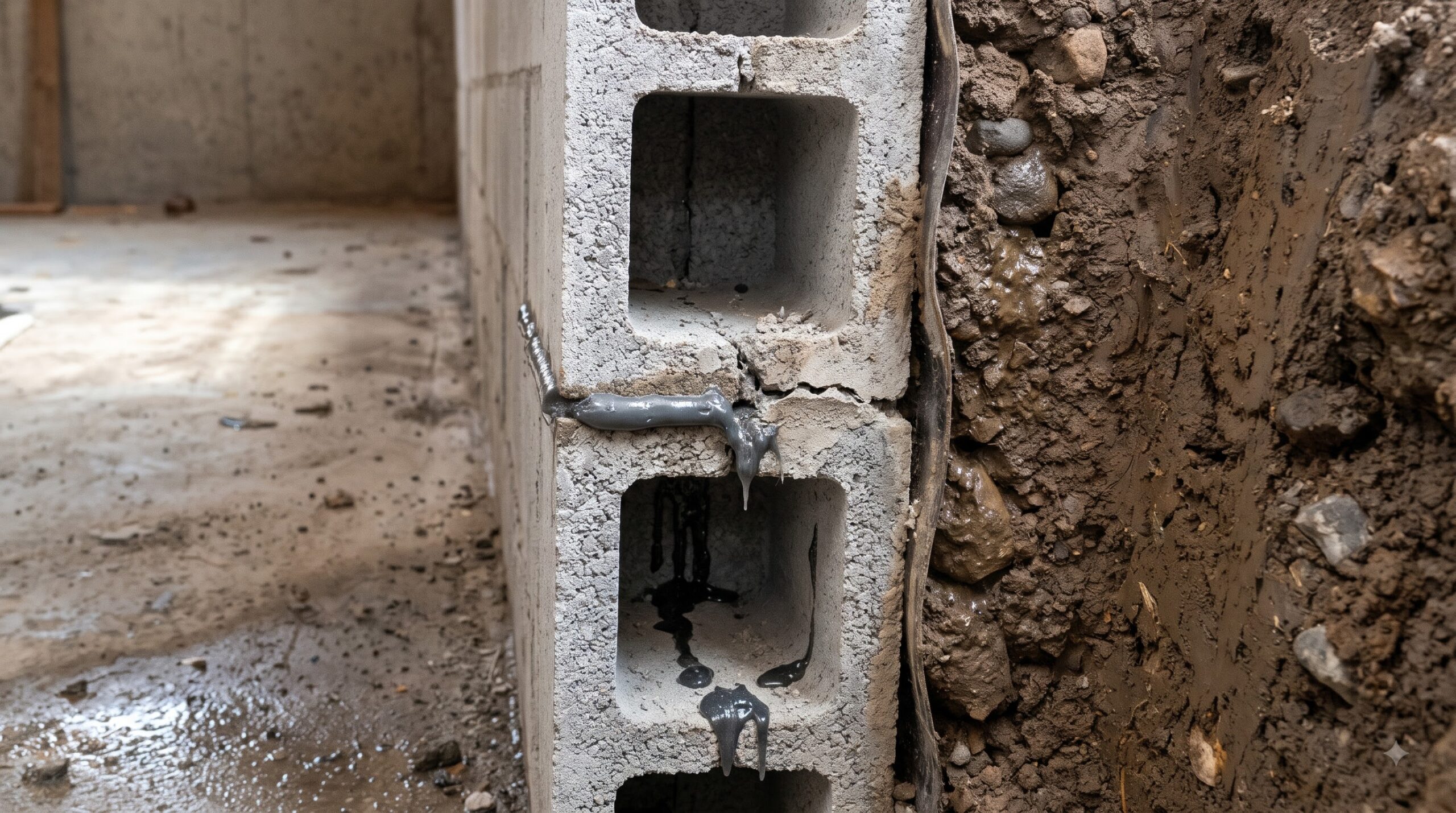
Homeowners who discover a horizontal crack across their basement wall often hope a $500 to $1,200 epoxy injection kit or contractor seal will permanently solve the problem. Understanding why epoxy crack injection fails on horizontal basement block wall fractures comes down to basic structural physics: epoxy injection is designed to glue static, solid poured concrete back together, whereas a horizontal crack in a hollow concrete block wall is an active bending failure driven by thousands of pounds of outside soil and water pressure. Simply gluing a horizontal mortar joint shut does nothing to stop the earth outside from continuing to push the wall inward.
When you inject rigid epoxy into a bowing cinder block wall without first installing vertical structural reinforcement, the repair almost always fails within one to three seasonal freeze-thaw or heavy rain cycles. Either the low-viscosity resin disappears into the empty hollow cores inside the blocks, or the hardened epoxy creates a brittle strip that forces the expanding soil to snap a brand-new crack right above or below the sealed joint. Permanently stabilizing a cracked block wall requires neutralizing lateral soil pressure first with vertical carbon fiber straps, steel I-beams, or wall anchors—and using mortar tuckpointing or sealants only after the wall is structurally locked in place.
The Physics of Lateral Hydrostatic Pressure on Block Walls
To see why epoxy crack injection fails on horizontal basement block wall structures, you first have to look at the forces pushing against your basement from the outside. Below-grade foundation walls act like retaining walls holding back tons of earth. According to the HUD Residential Structural Design Guide, soil backfill exerts a triangular lateral load that starts near zero at ground level and grows steadily heavier toward the bottom of the wall.
Under International Building Code (IBC) lateral soil load standards, dense clay soils exert roughly twice as much horizontal pressure per foot of depth as clean, well-drained sand or gravel. When clogged gutters, short downspouts, or flat yard grading allow rainwater to saturate clay soil around your foundation, two compounding forces hit the wall:
- Hydrostatic Water Pressure: Water trapped in heavy soil adds roughly 62.4 pounds per cubic foot of fluid weight, pushing directly against the exterior masonry face.
- Expansive Clay Swelling & Frost Heave: Clay soils swell outward when wet, and freezing temperatures near the upper soil zone expand trapped moisture with immense lateral force.
Concrete masonry unit (CMU) block walls carry vertical weight from your house well, because the weight of the roof and floors compresses the blocks straight down. However, hollow concrete blocks stacked with thin mortar joints have almost zero resistance against sideways bending. Because the bottom row of blocks is pinned by the concrete basement floor slab and the top row is held by the wooden sill plate and floor joists, the middle of the wall bows inward like a wooden plank overloaded in the center. Once that bending force exceeds the weak grip of the mortar, the joint splits open horizontally along the third, fourth, or fifth block course.
3 Engineering Reasons Epoxy Crack Injection Fails on Block Walls
Epoxy crack injection works reliably on narrow, non-moving vertical shrinkage cracks in solid poured concrete walls, where two solid concrete faces sit millimeters apart and can be welded together into a monolithic slab. On a horizontal crack in a concrete block wall, three physical problems cause epoxy injection to fail.
1. Hollow CMU Cores Drain Epoxy Resin Away From the Joint
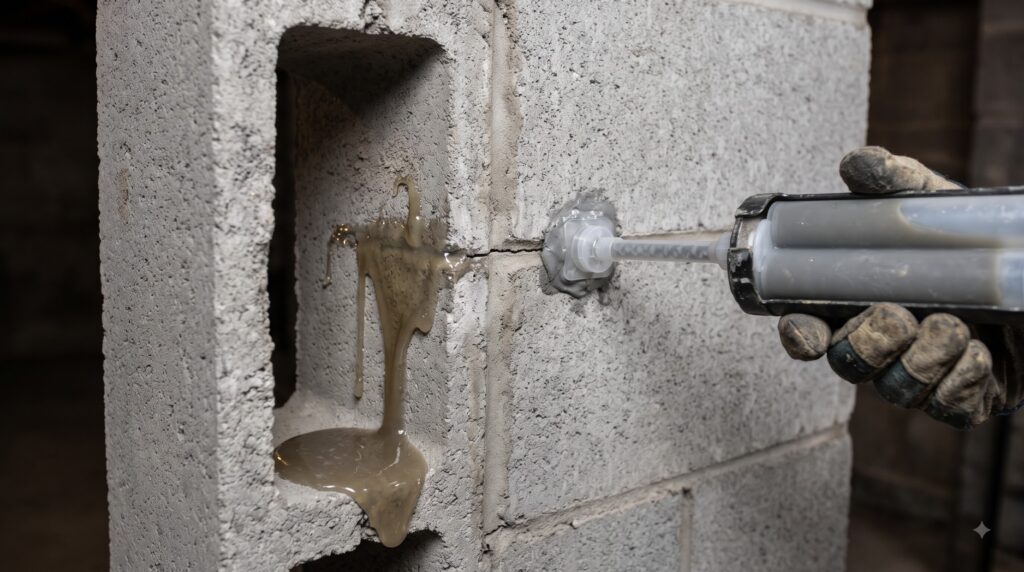
Unlike solid poured concrete walls, standard 8-inch and 12-inch concrete blocks contain large hollow vertical cavities (cores) separated by thin concrete face shells roughly 1-1/4 inches thick. When a technician drills injection ports along a horizontal mortar crack and pumps low-viscosity liquid epoxy into the joint, there is no solid back wall to contain the resin.
Instead of filling the thin horizontal mortar seam under pressure, the liquid epoxy flows straight through the broken mortar bed and pours down inside the empty hollow cores of the blocks. Contractors can pump gallons of expensive resin into a block wall without ever achieving a continuous structural bond across the fractured face shells.
2. Brittle Epoxy Creates a Rigid Hinge Under Continuous Soil Pressure
Structural epoxy cures into an extremely hard, rigid plastic with high compressive strength—often stiffer than the surrounding concrete block and mortar—but very little flexibility. Once cured, it locks that single horizontal joint into a rigid band while leaving the rest of the masonry wall completely unreinforced against sideways bending.
Because the exterior soil and groundwater pressure has not been relieved, the wall continues to flex inward every time heavy spring rains or winter frost saturate the yard. Unable to bend at the newly stiffened epoxy strip, the lateral stress concentrates immediately above or below the repair. Within months, the masonry tears open along the next weakest mortar line or fractures straight through the concrete block face shell parallel to the epoxy bead.
3. Epoxy Cannot Resist Out-of-Plane Bending or Base Shear
In engineering terms, a horizontal crack caused by soil pressure is an out-of-plane flexural bending failure—and in advanced cases, a base shear failure where the wall above the first or second block course slides inward across the floor slab.
Epoxy paste applied along a 3/8-inch horizontal seam has almost zero leverage against a wall bowing inward across an 8-foot vertical span. Even if every square millimeter of the mortar joint were bonded with industrial epoxy, the thin horizontal glue line cannot act as a vertical beam. Without vertical reinforcement spanning from the concrete footing up to the floor framing, lateral earth loads continue bending the wall inward toward collapse.
Epoxy Injection vs. Polyurethane Foam vs. Structural Reinforcement
Many homeowners and general handymen confuse crack sealants with structural wall stabilization. Comparing how common repair materials behave under lateral soil load makes it clear why vertical bracing must come first.
| Repair Method | Primary Purpose | Works on Hollow Block Walls? | Resists Lateral Soil Pressure? | Typical Outcome on Horizontal Block Cracks |
| Epoxy Crack Injection | Structural bonding of static poured concrete cracks | Poor (resin leaks into hollow block cores) | No (no vertical bending resistance) | Snaps or causes parallel cracks to open above/below the seal |
| Polyurethane Foam Injection | Flexible water stoppage in damp or leaking cracks | Limited (fills voids/blocks water only) | No (zero structural load capacity) | Keeps water out temporarily while wall continues bowing inward |
| Hydraulic Cement Patch | Surface water plugging at floor-wall joints | Surface only (sits on outer face) | No (brittle surface plug) | Crumbles and pops out as seasonal soil movement continues |
| Vertical Carbon Fiber Straps | Passive tensile reinforcement for bowing < 2 inches | Yes (epoxied vertically across block faces) | Yes (locks wall against further bowing) | Permanently stops inward bending when paired with top/bottom anchors |
| Steel I-Beam Wall Bracing | Rigid mechanical support for bowing ≥ 2 inches | Yes (anchored to slab/footing & floor joists) | Yes (blocks bending and base shear) | Permanently stabilizes severe bowing and allows gradual straightening |
For a complete comparison of when to choose composite straps versus steel columns once your wall is ready for reinforcement, see our guide on Horizontal Crack Block Foundation Wall Repair: Carbon Fiber vs I Beam.
How to Tell If a Previous Epoxy Repair Is Already Failing
If a previous owner or contractor already applied epoxy over a horizontal crack in your basement, inspect the wall closely for these four warning signs of active failure:
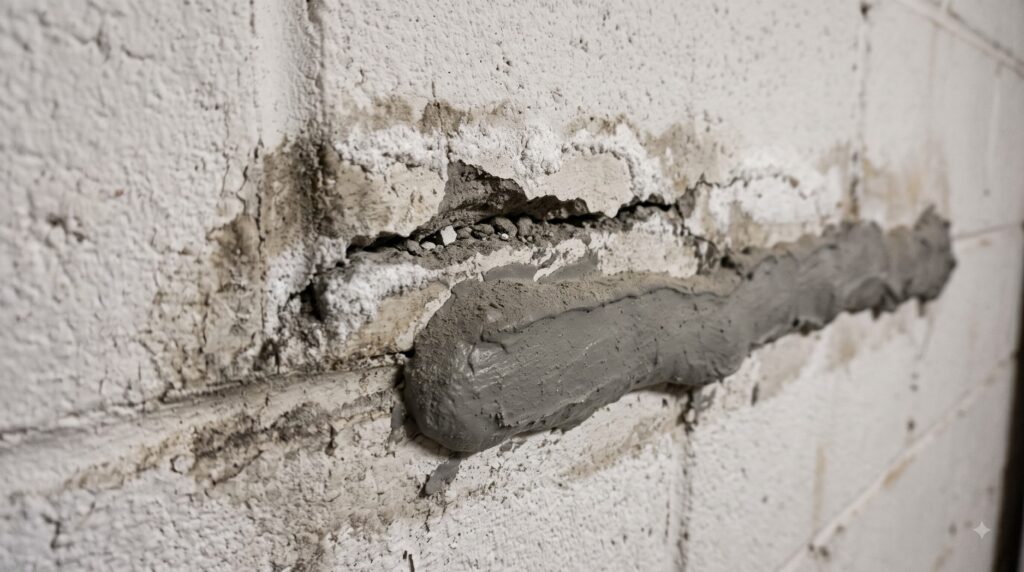
- Parallel Hairline Cracks: Look 1/2 inch to 3 inches directly above or below the gray epoxy strip. New jagged cracks running parallel to the old repair confirm that soil pressure is still bending the wall.
- Delaminated or Popped Epoxy Beads: Tap lightly along the cured epoxy strip with the handle of a screwdriver. Hollow clicking sounds or edges peeling away from the concrete block show that moisture and wall flexing have broken the surface bond.
- Increased Inward Bowing: Hang a plumb line from the wooden sill plate down to the basement floor and measure the gap at the crack height. If the wall bows inward more than 1/2 inch—or if you notice a horizontal shelf where blocks have slid inward near the floor—the wall needs structural bracing immediately.
- Fresh Efflorescence and Damp Streaks: White chalky mineral deposits or dampness weeping through or around the epoxy seal indicate trapped groundwater building hydrostatic pressure inside the hollow block cores.
The Correct Engineering Sequence: Vertical Reinforcement First
Repairing a cracked concrete block wall permanently requires reversing the typical DIY order: you must stop the wall from moving before sealing the crack. Following this four-step sequence protects your foundation without unnecessary wall replacement:
- Measure Deflection and Check for Base Sliding: Use a plumb line or vertical laser level to measure how far the wall bows inward at the horizontal crack. Walls bowing less than 2 inches with no bottom-course sliding qualify for vertical carbon fiber reinforcement, while walls bowing 2 inches or more require structural steel I-beams or soil-anchored tiebacks. Review our step-by-step guide on how to repair horizontal foundation crack without wall replacement for full measurement instructions.
- Relieve Exterior Hydrostatic Water Pressure: Clean clogged gutters, extend downspouts at least 5 to 10 feet away from the house, and slope yard soil downward away from the foundation. If groundwater collects inside the hollow block cores, install an interior sub-slab perimeter French drain with weep holes drilled into the bottom row of blocks to drain trapped water to a sump pump.
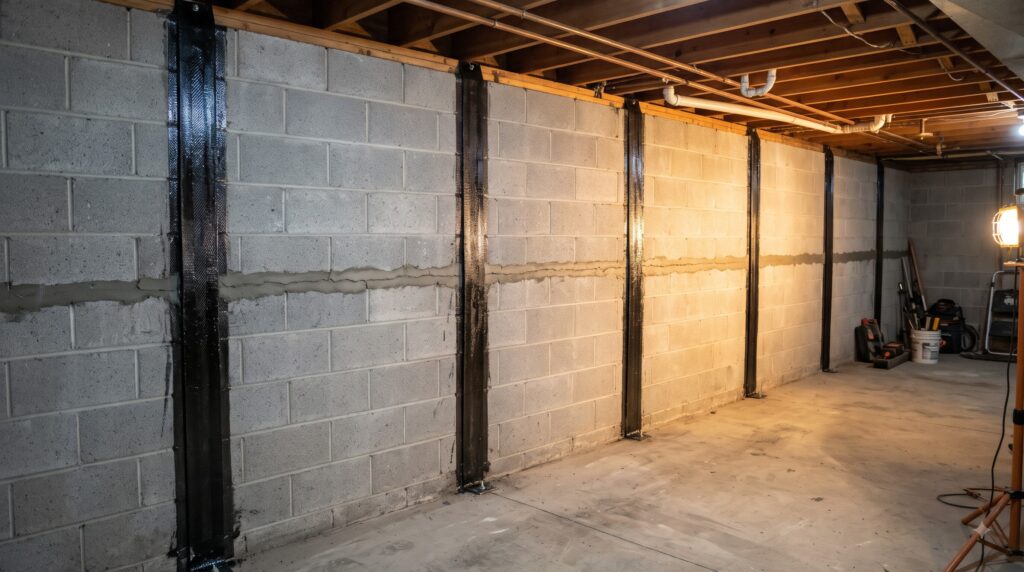
- Install Vertical Structural Reinforcement: Bond structural carbon fiber reinforcement straps vertically every 4 feet with mechanical sill and footing anchors (for bowing under 2 inches), or anchor heavy-duty steel I-beams into the concrete slab and overhead floor joists every 36 to 50 inches (for bowing of 2 inches or more). Vertical reinforcement spans across the horizontal crack, transferring lateral soil pressure safely into the floor framing and concrete footing.
- Tuckpoint or Seal the Mortar Joint Last: Only after vertical straps or steel beams have locked the masonry against inward bending should you grind out loose mortar and tuckpoint the horizontal joint with fresh Type S or Type N masonry mortar (or apply flexible sealant) to block basement moisture and soil gases.
Frequently Asked Questions
Why does epoxy crack injection fail on horizontal basement block walls?
Epoxy crack injection fails on horizontal basement block walls because hollow cinder blocks allow liquid resin to drain into empty internal cavities, and rigid epoxy provides zero vertical bending strength against lateral hydrostatic soil pressure. Without vertical reinforcement, wet clay soil continues pushing the wall inward and snaps new cracks right beside the hardened epoxy seal.
Can you use epoxy injection on a poured concrete basement wall instead?
Yes, low-pressure epoxy injection works well on narrow, non-structural vertical shrinkage cracks in solid poured concrete walls because there are no hollow cores for the resin to escape into. However, if a poured concrete wall has a wide horizontal crack caused by inward soil bowing, it still requires vertical carbon fiber straps, steel I-beams, or wall anchors in addition to epoxy injection.
Should you seal a horizontal block wall crack before installing carbon fiber straps?
Yes, as part of the carbon fiber installation process, technicians grind the block surface clean, fill the open horizontal mortar joint with high-strength structural epoxy paste so the block face is flat, and immediately bond vertical carbon fiber straps across the joint with top and bottom anchors. The epoxy paste levels the surface, while the vertical carbon fiber straps carry the actual structural load.